✊ State File (terraform.tfstate)
→ Terraform’s memory
→ Stores unique ID for each resource, attributes
👉 State = Terraform’s source of truth. (Never Delete)
Must be:
- Protected
- Not edited manually
- Stored remotely (S3 + DynamoDB lock recommended)
⭐ State File Lifecycle
Every Terraform command uses the state file:
-
terraform init
→ initializes backend
→ downloads providers
→ prepares state handling (no lock) -
terraform plan
→ reads currenttfstate
→ reads real infra (AWS)
→ shows diff only (no change, no lock) -
terraform apply
→ acquires state lock (.terraform.tfstate.lock.info) → reads current state
→ updates real infra
→ writes updated state
→ releases lock -
terraform destroy
→ acquires state lock
→ deletes real infra
→ updates state
→ releases lock -
terraform refresh (implicit)
→ syncs state with real infra
→ no changes applied
⭐ Useful Terraform State Commands
Syntax:
terraform state <subcommand> [options] [args]| Command | Use |
|---|---|
terraform state list | Shows all managed resources |
terraform state show <resourceType.resourceName> | Shows details of a resource from state |
terraform state pull | Downloads and prints remote state |
terraform state rm <resourceType.resourceName> | Removes resource from state (unmanaged) |
terraform state mv <resourceType.resourceName1> <resourceType.resourceName2> | Renames or moves a resource in state |
☁️ Remote Backend – TF State
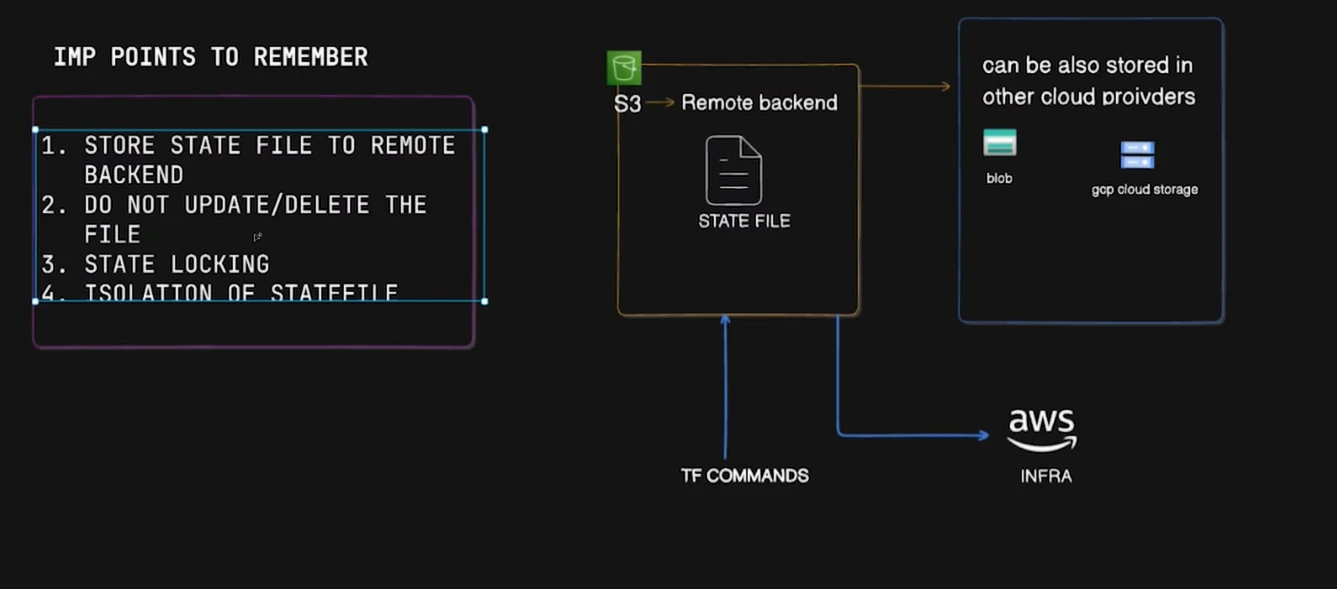
⭐ Remote Backend (S3)
Remote backend stores state in AWS S3 instead of local.
Benefits:
- ✔ Secure, centralized storage
- ✔ Versioning & backups
- ✔ Team collaboration
- ✔ Locking → Prevents two people running Terraform at the same time.
Backend block: Backend bucket must always exist before Terraform runs.
terraform {
  backend "s3" {
    bucket         = "my-tf-state"
    key            = "dev/terraform.tfstate"
    region         = "us-east-1"
    encrypt        = true
    use_lockfile   = true
  }
}
⭐ Remote State File Structure (S3)
Example S3 folder:
my-tf-state/
  dev/terraform.tfstate
  test/terraform.tfstate
  prod/terraform.tfstate
Use separate state for:
✔ dev
✔ test
✔ prod