Bubble sort
📌 Key Idea: In every pass, the maximum element goes (bubble up) to its correct position at the end of the array.
void bubble(vector<int> &arr)
{
    int n = arr.size();

    for (int i = 0; i < n; i++)
    {
        for (int j = 0; j < n - 1; j++)
        {
            if (arr[j] > arr[j + 1])
            {
                swap(arr[j], arr[j + 1]);
            }
        }
    }
}

/*
Optimizations:

1. Outer loop runs only till n-1
   * After (n-1) passes, the array is guaranteed to be sorted.

2. Inner loop runs till (n-1-i)
   * After every pass, the largest element moves to its correct position.
   * Therefore, the last i elements are already sorted and can be skipped.

3. Early termination
   * If no swap occurs during a pass, the array is already sorted.
   * Stop further processing using a flag.
*/
void bubbleOptimized(vector<int> &arr)
{
    int n = arr.size();

    for (int i = 0; i < n - 1; i++)
    {
        bool isSorted = true;

        for (int j = 0; j < n - 1 - i; j++)
        {
            if (arr[j] > arr[j + 1])
            {
                swap(arr[j], arr[j + 1]);
                isSorted = false;
            }
        }

        if (isSorted)
            break;
    }
}| Case | Time Complexity |
|---|---|
Best Case (already sorted) isSorted = true | O(n) |
| Worst Case | O(n²) |
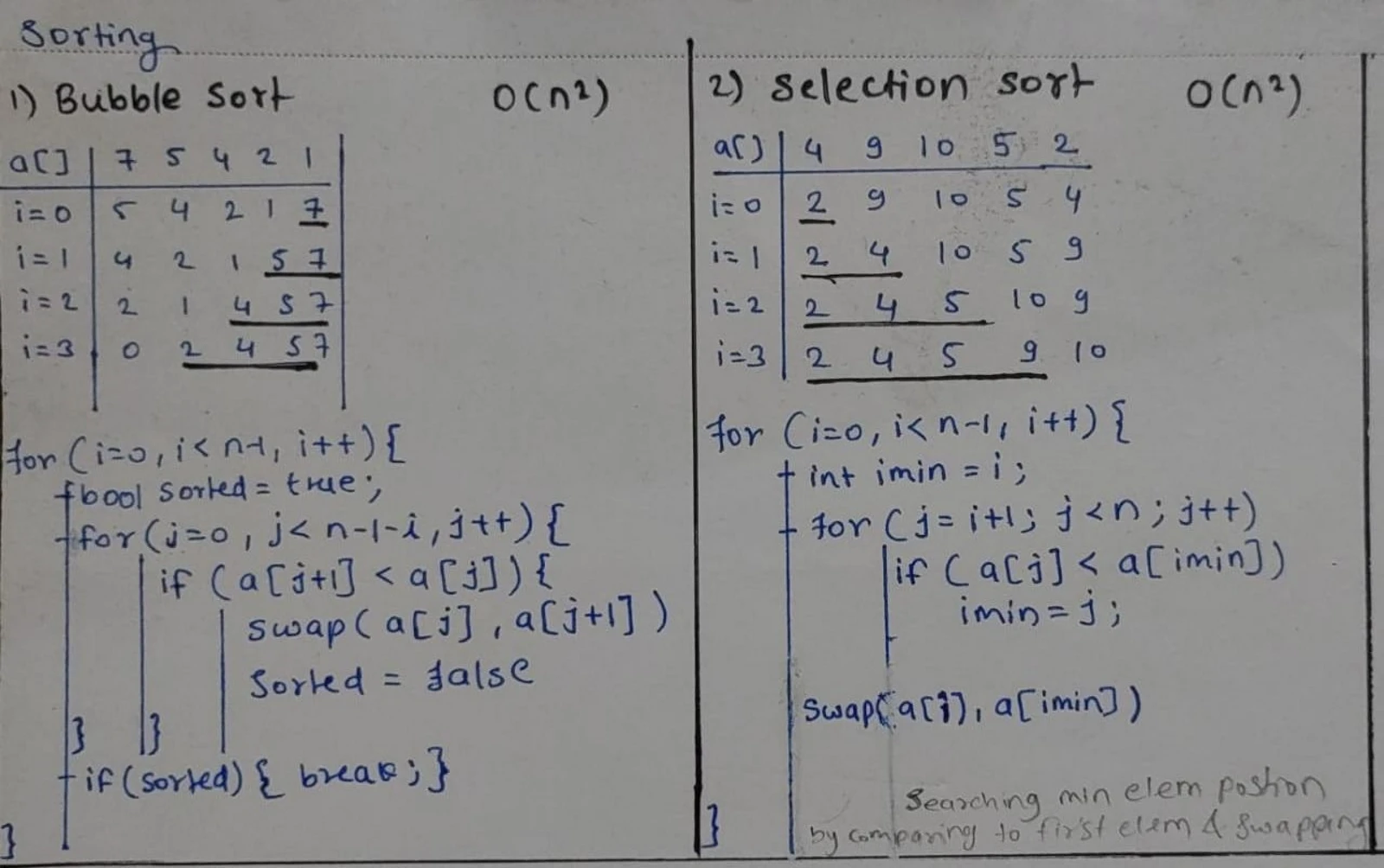
Selection Sort
📌 Key Idea: In every pass, find the smallest element correct position in the sorted postion at front
void selectionsort (int a[], int n) {
    for (int i = 0; i < n - 1 ; i++) {
        //step 1 --> temperory set
        int imin = i; // ith position

        //step 2 --> finding imin
        for (int j = i + 1 ; j < n ; j++) {
            if (a[j] < a[imin])
            {
                imin = j;
            }
        }

        //step 3 --> swaping
        swap(a[i], a[imin]);
    }
}
Insertion Sort
📌 Key Idea: Build the sorted portion one element at a time by inserting the current element into its correct position among the already sorted elements.
void insertionSort(vector<int>& arr) {
    int n = arr.size();

    // [Sorted Array] [Curr Element] [Unsorted Array]

    // Outer loop -> pick elements one by one
    for (int i = 1; i < n; i++) {

        // Inner loop -> move current element to correct position in sorted Array
        for (int j = i; j > 0; j--) {

            // Swap if left element is bigger
            if (arr[j] < arr[j - 1]) {
                swap(arr[j], arr[j - 1]);
            }
            else {
                break; // already sorted
            }
        }
    }
}

[5, 3, 4, 1]

Pass 1:
[3, 5, 4, 1]

Pass 2:
[3, 4, 5, 1]

Pass 3:
[1, 3, 4, 5]| Case | Time Complexity |
|---|---|
| Best Case (already sorted) | O(n) |
| Worst Case (reverse sorted) | O(n²) |
Stability of Sorting Algorithms
A sorting algorithm is stable if equal elements maintain their relative order after sorting.
Example:
[(5,A), (3,X), (5,B)]

[(3,X), (5,A), (5,B)] # Stable sorted
A remains before B, so the sort is stable.
Note
Stable ✅ = Bubble, Insersion, Merge Not Stable ❌ = selection, quick, HeapSort
Merge Sort
📌 Key Idea: Divide the array into two halves, recursively sort both halves, then merge the sorted halves.
void merge(vector<int>& nums, int l, int mid, int r)
{
    vector<int> sorted;

    int l1 = l;
    int r1 = mid;

    int l2 = mid + 1;
    int r2 = r;

    while (l1 <= r1 && l2 <= r2)
    {
        if (nums[l1] <= nums[l2])
            sorted.push_back(nums[l1++]);
        else
            sorted.push_back(nums[l2++]);
    }

    while (l1 <= r1)
        sorted.push_back(nums[l1++]);

    while (l2 <= r2)
        sorted.push_back(nums[l2++]);

    for (auto &ele : sorted)
        nums[l++] = ele;
}

void mergeSort(vector<int>& nums, int l, int r)
{
    if (l >= r)
        return;

    int mid = l + (r - l) / 2;

    mergeSort(nums, l, mid);      // Left Half
    mergeSort(nums, mid + 1, r);  // Right Half

    merge(nums, l, mid, r);
}
Time Complexity
| Component | Time |
|---|---|
| Merge Sorted Array Fun | O(n) |
| Recursion Stack | O(log n) as getting split in half recursively |
Space Complexity
| Component | Space |
|---|---|
| Temporary Array in Merge Fun | O(n) |
| Recursion Stack | O(log n) |
Questions
Count Inversions (GFG) Find All nums[i] > nums[j] for i<j
// GFG - Count Inversions

class Solution {
public:
    int InvCount = 0;

    void countInversion(vector<int> &nums, int l1, int r1, int l2, int r2) {
        while (l1 <= r1 && l2 <= r2) {
            if (nums[l1] > nums[l2]) {
                InvCount += (r1 - l1 + 1);
                l2++;
            } else {
                l1++;
            }
        }
    }

    void merge(vector<int>& nums, int l, int mid, int r) {
        vector<int> sorted;

        int l1 = l, r1 = mid;
        int l2 = mid + 1, r2 = r;

        countInversion(nums, l1, r1, l2, r2);

        while (l1 <= r1 && l2 <= r2) {
            nums[l1] <= nums[l2]
                ? sorted.push_back(nums[l1++])
                : sorted.push_back(nums[l2++]);
        }

        while (l1 <= r1)
            sorted.push_back(nums[l1++]);

        while (l2 <= r2)
            sorted.push_back(nums[l2++]);

        for (auto &ele : sorted)
            nums[l++] = ele;
    }

    void mergeSort(vector<int>& nums, int l, int r) {
        if (l >= r)
            return;

        int mid = l + (r - l) / 2;

        mergeSort(nums, l, mid);
        mergeSort(nums, mid + 1, r);

        merge(nums, l, mid, r);
    }

    int inversionCount(vector<int>& nums) {
        mergeSort(nums, 0, nums.size() - 1);
        return InvCount;
    }
};
Reverse Pairs (LeetCode 493) Find All nums[i] > 2 * nums[j] for i<j`
// LeetCode 493 - Reverse Pairs

class Solution {
public:
    int InvCount = 0;

    void countInversion(vector<int> &nums, int l1, int r1, int l2, int r2) {
        while (l1 <= r1 && l2 <= r2) {
            if ((long long)nums[l1] > 2 * (long long)nums[l2]) {
                InvCount += (r1 - l1 + 1);
                l2++;
            } else {
                l1++;
            }
        }
    }

    void merge(vector<int>& nums, int l, int mid, int r) {
        vector<int> sorted;

        int l1 = l, r1 = mid;
        int l2 = mid + 1, r2 = r;

        countInversion(nums, l1, r1, l2, r2);

        while (l1 <= r1 && l2 <= r2) {
            nums[l1] <= nums[l2]
                ? sorted.push_back(nums[l1++])
                : sorted.push_back(nums[l2++]); // we can remove countInversion & add  InvCount+=(r1-l1+1) here for optimization to avoid extra n loop
        }

        while (l1 <= r1)
            sorted.push_back(nums[l1++]);

        while (l2 <= r2)
            sorted.push_back(nums[l2++]);

        for (auto &ele : sorted)
            nums[l++] = ele;
    }

    void mergeSort(vector<int>& nums, int l, int r) {
        if (l >= r)
            return;

        int mid = l + (r - l) / 2;

        mergeSort(nums, l, mid);
        mergeSort(nums, mid + 1, r);

        merge(nums, l, mid, r);
    }

    int reversePairs(vector<int>& nums) {
        mergeSort(nums, 0, nums.size() - 1);
        return InvCount;
    }
};
Quick Sort
📌 Key Idea: Pick a pivot element, place it in its correct sorted position, then recursively sort the left and right partitions.
int partition(vector<int>& nums, int l, int r)
{
    int pivot = nums[r];
    int pIndex = l;

    for (int i = l; i < r; i++)
    {
        if (nums[i] < pivot)
        {
            swap(nums[pIndex], nums[i]);
            pIndex++;
        }
    }

    swap(nums[pIndex], nums[r]);

    return pIndex;
}

void quickSort(vector<int>& nums, int l, int r)
{
    if (l >= r)
        return;

    int p = partition(nums, l, r);

    quickSort(nums, l, p - 1);
    quickSort(nums, p + 1, r);
}
nums = [4, 2, 8, 1, 7, 3]
Pivot = 3
After partition:
[2, 1] | 3 | [8, 7, 4]
Pivot Index = 2Time Complexity
| Case | Time Complexity |
|---|---|
| Best Case | O(n log n) |
| Worst Case | O(n²) |
| Space Complexity |
| Component | Space |
|---|---|
| Recursion Stack (Average) | O(log n) |
| Recursion Stack (Worst) | O(n) |
📌 Interview Tip:
| Algorithm | Average | Worst | Space |
|---|---|---|---|
| Merge Sort | O(n log n) | O(n log n) | O(n) |
| Quick Sort | O(n log n) | O(n²) | O(log n) |
Comparison of Basic Sorting Algorithms
| Property | Bubble Sort | Selection Sort | Insertion Sort | Merge Sort | Quick Sort |
|---|---|---|---|---|---|
| Best Time | O(n) | O(n²) | O(n) | O(n log n) | O(n log n) |
| Average Time | O(n²) | O(n²) | O(n²) | O(n log n) | O(n log n) |
| Worst Time | O(n²) | O(n²) | O(n²) | O(n log n) | O(n²) |
| Space Complexity | O(1) | O(1) | O(1) | O(n) + O(log n) | O(log n) |
| Stable | ✅ | ❌ | ✅ | ✅ | ❌ |
| In-Place | ✅ | ✅ | ✅ | ❌ | ✅ |
| Best For | Small / Nearly Sorted | Minimizing Swaps | Nearly Sorted Arrays | Guaranteed Performance | Fast Practical Sorting |
In-Place:- It modifies the original array directly instead of creating another array.
| If Asked… | Choose |
|---|---|
| Small, nearly sorted array | Insertion Sort |
| Need stable sorting | Merge Sort / Insertion Sort |
Need guaranteed O(n log n) | Merge Sort |
Need in-place O(n log n) average | Quick Sort |
| Minimum swaps required | Selection Sort |
| Best practical performance | Quick Sort |
| Linked List Sorting | Merge Sort |
| External Sorting (Huge Files) | Merge Sort |
C++ STL
std::sort()uses Introsort, a hybrid ofQuick Sort + Heap Sort + Insertion Sort. It providesO(n log n)worst-case time complexity while maintaining excellent practical performance.