1. What is a Graph Database
A database optimized for storing and querying relationships between entities.
Node ──Relationship──> Node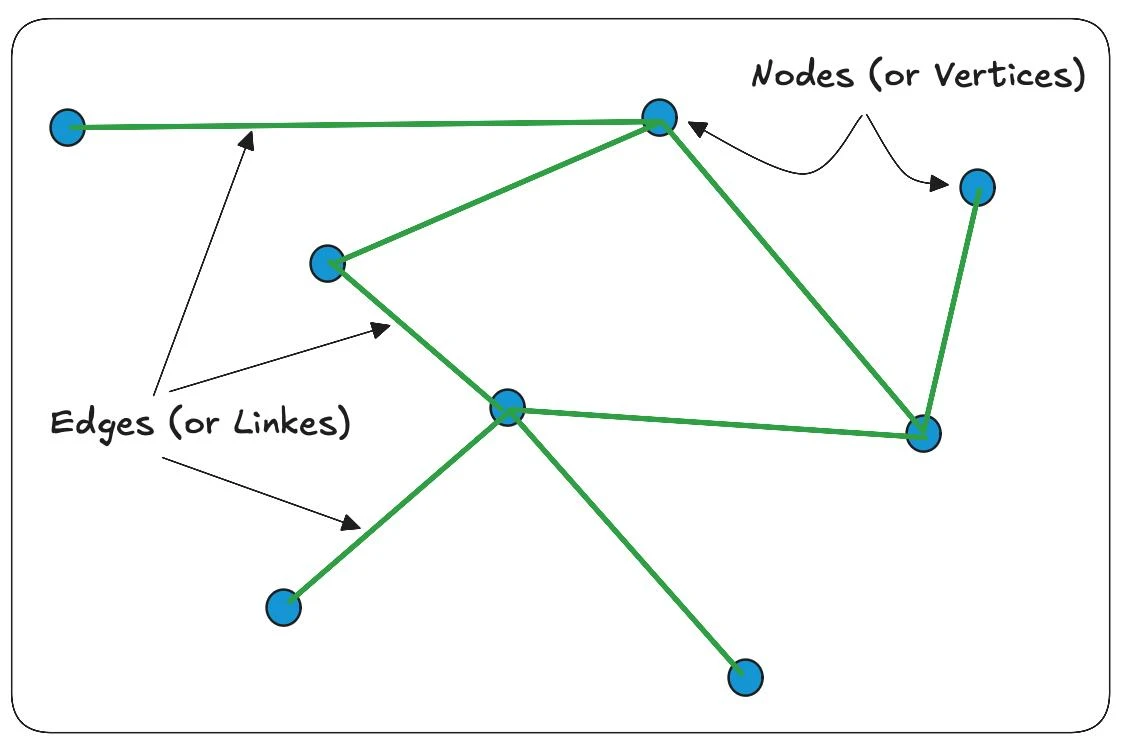
Core building blocks
Node
  ├── ID
  ├── Labels / Type
  └── Properties

Relationship
  ├── Type
  ├── Direction
  └── Properties
Example:
(Alice) ──FOLLOWS──> (Bob)
  │                    │
  │                    └──WORKS_AT──> (Google)
  │
  └──BOUGHT──> (iPhone)
Key idea: Relationships are first-class data, not just foreign keys.
2. When should I use a Graph DB?
Use it when relationships are central to the queries.
Common System Design use cases
| Use case | Example traversal |
|---|---|
| Social Network | User → Friends → Friends |
| Recommendation | User → Product → Category → Product |
| Fraud Detection | Account → Transaction → Account |
| Knowledge Graph | Person → Company → Product |
| Dependency Graph | Service → Dependency → Service |
| Network/Topology | Router → Link → Router |
| Access Control | User → Group → Role → Permission |
If the problem is primarily about “how are things connected?”, consider a Graph DB.
3. Why not SQL?
SQL can represent a graph via Users and Relationships tables, e.g. Users(id, name) and Friendships(user_id, friend_id).
A simple query like “Who are Alice’s friends?” is fine. But:
Alice → Friends → Friends of Friends → Friends of Friends of Friendsrequires repeated JOINs / lookups. As traversal gets deeper:
1-hop → 2-hop → 3-hop → 4-hop → ...the query becomes increasingly expensive and complex.
Graph DB
Instead:
Alice → Edge → Bob → Edge → CharlieThe database is designed to traverse relationships directly.
4. Why is Graph DB fast?
Index-Free Adjacency ⭐
This is the most important concept.
In a native graph database, nodes maintain references to their relationships, and relationships reference connected nodes. Conceptually:
Alice --pointer--> FOLLOWS --pointer--> BobSo traversal is approximately:
Node → Edge → Node → Edge → Noderather than:
Node → Index lookup → Relationship table → Index lookup → NodeKey statement
Index-free adjacency means traversing from one node to a connected node doesn’t require an index lookup; the relationship itself provides the path to the next node.
This is why native graph databases are particularly good at deep relationship traversal.
5. Complexity intuition
Don’t say “Graph traversal is O(1).” That’s misleading.
Instead:
- Following one relationship:
≈ O(1) - Traversing K relationships:
≈ O(K)
The important property is:
Traversal cost depends primarily on the portion of the graph being traversed, rather than the total number of nodes in the database.
Example: with 1 billion nodes, a query like:
Alice → friends → friendsmay only need to visit a relatively small neighborhood around Alice. This is called localized traversal.
6. Native vs Non-Native Graph DB
Non-native
Graph capabilities are built on top of another storage system:
Graph API/Query → Underlying DB → Tables/DocumentsThe graph is essentially an abstraction over another database.
Native
The storage engine itself is designed around graph structures:
Graph Query → Graph Processing → Native Graph StorageExample: Neo4j is a well-known native graph database.
Interview takeaway
Native graph databases can optimize both storage and traversal for graph workloads.
7. Graph DB vs SQL vs NoSQL
| SQL | NoSQL | Graph DB | |
|---|---|---|---|
| Primary strength | Structured data + transactions | Scale/flexible data models | Relationships |
| Data model | Tables | Documents/KV/Columns | Nodes + Edges |
| Relationships | Foreign keys + JOINs | Usually application-managed | First-class |
| Deep traversal | ❌ Expensive | ❌ Usually awkward | ✅ Excellent |
| Schema | Usually structured | Flexible | Flexible |
| Transactions | ✅ Strong | Depends | Depends |
| Best for | Orders, payments, users | Large-scale KV/doc workloads | Social/fraud/recommendation |
Important: This doesn’t mean Graph DB replaces SQL/NoSQL. Choose based on the access pattern.
8. Graph Data Modeling
Think in terms of: Entities → Nodes, Relationships → Edges, Attributes → Properties.
Example:
(User) ──PURCHASED──> (Product) ──BELONGS_TO──> (Category)Properties:
User: id, namePURCHASED: timestamp, quantityProduct: id, price
Relationship properties are important
Unlike a simple foreign key Alice → Bob, the edge itself can contain properties, e.g. FOLLOWED { since, source }.
So:
Alice ──FOLLOWS {since: 2024}──> Bob9. Direction matters
Relationships can be directed:
Alice ──FOLLOWS──> BobThis does not necessarily mean:
Bob ──FOLLOWS──> AliceFor social networks, this distinction is important:
Alice ──FOLLOWS──> Bob
Charlie ──FOLLOWS──> Bob
Now we can ask “Who follows Bob?” — that’s a reverse traversal. Native graph systems are designed to support these relationship traversals efficiently.
10. Flexible Schema
Graph databases generally allow the graph model to evolve easily.
Initially:
User ──FOLLOWS──> UserLater:
User ──FOLLOWS──> User
User ──WORKS_AT──> Company
User ──OWNS──> Car
User ──PURCHASED──> Product
You don’t necessarily need to redesign a large collection of relational tables whenever a new relationship type appears. This flexibility is particularly useful for evolving domains and knowledge graphs.
11. Graph DB is NOT always better
Don’t use Graph DB just because:
“We have relationships.” Almost every application has relationships.
Use it when:
Relationship traversal is a dominant access pattern.
For example:
Banking transaction
“Get account balance” / “Get transaction by ID” — SQL is usually a better fit.
Fraud detection
Account → Device → Account → Transaction → Account → DeviceGraph DB becomes much more attractive.
12. Main Trade-offs
✅ Advantages
- Excellent for relationship-heavy workloads
- Fast multi-hop traversal
- Index-free adjacency in native implementations
- Relationships are first-class
- Flexible/evolving data model
- Natural representation of connected data
❌ Disadvantages
- Not ideal for every workload
- Distributed graph partitioning can be difficult
- Cross-partition traversals are expensive
- Distributed transactions can require coordination
- Operational complexity can be higher
- Ecosystem/query patterns may be less familiar than SQL
13. Distributed Graph DB ⭐
This is a good deep-dive interview topic.
Imagine two partitions:
Partition 1: A ── B
Partition 2: C ── D
Cross-link: B ── C
If traversal crosses partitions:
A → B → C (B → C hop is a network call)So traversal isn’t just Node → Edge → Node, it can become:
Node → Edge → NETWORK → Another partition → NodeNetwork latency becomes important.
Key principle
Graph partitioning is difficult because highly connected nodes can create cross-partition traversals.
14. ACID / Transactions
Graph databases can support transactions.
Suppose:
A ──> B ──> Cand one transaction must update A + B + C. We want ALL SUCCESS or ALL ROLLBACK.
If A, B and C are on different machines, this becomes a distributed transaction and may require coordination such as Two-Phase Commit (2PC). This introduces latency and complexity.
15. Common Graph DB Technologies
Neo4j
Popular native graph database. Query language: Cypher.
Example:
MATCH (u:User)-[:FOLLOWS]->(friend)
WHERE u.name = "Alice"
RETURN friend
Other options
- Amazon Neptune
- JanusGraph
- TigerGraph
- ArangoDB
16. How to answer in an interview
Interviewer:
“Why would you choose a graph database?”
Answer:
“I’d choose a graph database when relationships and multi-hop traversal are core to the application’s access patterns. for example social graphs, recommendation systems, fraud detection, or knowledge graphs. Native graph databases provide index-free adjacency, allowing the database to traverse from node to node through stored relationships without repeatedly performing expensive joins or index lookups.”
17. 30-second mental model
Graph Database = Nodes (Entities) + Edges (Relationships)
  → Native Graph Storage
  → Index-Free Adjacency
  → Fast Multi-Hop Queries
  → (Social Network, Fraud Detection, Recommendation Engine)
⭐ The 5 things I’d memorize
1. What?
Nodes + relationships + properties.
2. When?
Relationship-heavy, multi-hop traversal.
3. Why fast?
Index-free adjacency / direct relationship traversal.
4. Why not SQL?
Deep traversals can require expensive joins and lookups.
5. Biggest distributed challenge?
Partitioning the graph and minimizing cross-partition traversals.
That is enough to handle most Graph DB questions in a System Design interview without getting lost in database-internals trivia.